
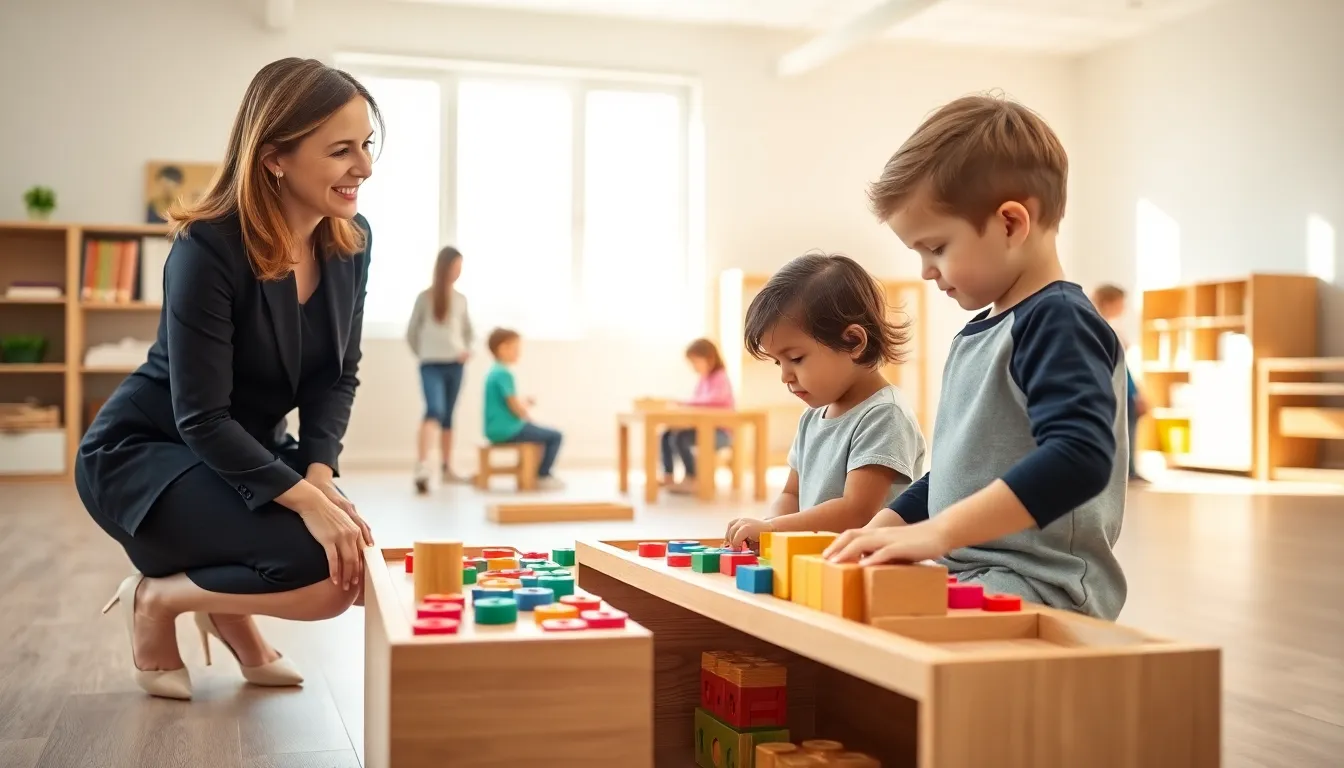
A Montessori guide plays a central role in child-centered education. Unlike traditional teachers who lead from the front of a classroom, a Montessori guide observes, supports, and facilitates each child’s natural learning journey. This approach stems from Dr. Maria Montessori’s philosophy that children learn best when they follow their own curiosity within a prepared environment.
Understanding what a Montessori guide does, and how they differ from conventional educators, can help parents, educators, and administrators make informed decisions about early childhood education. This article explains the role, responsibilities, training requirements, and unique philosophy that define a Montessori guide.
Table of Contents
ToggleKey Takeaways
- A Montessori guide facilitates learning by observing and supporting each child’s natural curiosity rather than delivering traditional lectures.
- The prepared environment is central to a Montessori guide’s role, with carefully arranged materials that encourage independence and exploration.
- Unlike traditional teachers, a Montessori guide gives individualized lessons based on each child’s readiness and assesses progress through observation rather than tests.
- Montessori guide certification requires specialized training through AMI or AMS, including coursework, hands-on practice, and supervised teaching experience.
- Mixed-age classrooms allow a Montessori guide to foster peer learning and social development through grace and courtesy lessons.
- Training is age-specific, meaning a guide certified for ages 3-6 must complete separate training to teach elementary-level students.
What Is a Montessori Guide?
A Montessori guide is an educator trained in the Montessori method who facilitates learning rather than directing it. The term “guide” reflects the core philosophy: adults should guide children toward discovery instead of delivering instruction through lectures or direct teaching.
Dr. Maria Montessori developed this approach in the early 1900s after observing how children naturally engage with their environment. She noticed that children thrive when given freedom to explore materials at their own pace. The Montessori guide creates the conditions for this exploration.
In practice, a Montessori guide prepares the classroom environment with carefully selected materials. They observe each child to understand their interests, developmental stage, and readiness for new challenges. When a child shows curiosity about a concept, the Montessori guide introduces appropriate materials and demonstrates their use.
The relationship between a Montessori guide and student looks different from traditional education. There’s less talking at children and more working alongside them. A Montessori guide might spend several minutes observing before offering any assistance. They trust children to make choices about their learning activities.
This doesn’t mean a Montessori guide takes a passive role. They actively manage the classroom environment, track each child’s progress, and make strategic decisions about when to introduce new concepts. The skill lies in knowing when to step in and when to step back.
Key Responsibilities of a Montessori Guide
A Montessori guide handles several distinct responsibilities that support child-centered learning.
Preparing the Environment
The classroom, called the “prepared environment”, requires constant attention. A Montessori guide arranges materials on low, accessible shelves. They rotate materials based on children’s developing interests and abilities. Everything has a specific place, which helps children develop order and independence.
The Montessori guide also maintains the aesthetic quality of the space. Materials should be clean, complete, and inviting. Broken items get repaired or replaced immediately. This attention to detail shows children that their learning environment matters.
Observing and Recording
Observation forms the foundation of a Montessori guide’s work. They watch children during free work periods, noting which materials attract attention, how long children concentrate, and where frustration or confusion appears. These observations inform decisions about introducing new lessons.
Most programs require Montessori guides to keep detailed records. They track which presentations each child has received, mastery levels, and social-emotional development. These records help ensure no child falls through the cracks.
Giving Individual and Small Group Lessons
A Montessori guide presents new materials through brief, focused demonstrations. These presentations typically involve one child or a small group. The guide shows how to use a material with minimal words, letting the child’s hands and mind do the learning.
After a presentation, children work independently with the material. The Montessori guide moves on to observe other children or give another lesson. This cycle of present-observe-record happens throughout each day.
Supporting Social Development
Montessori classrooms include mixed-age groups, usually spanning three years. A Montessori guide facilitates positive interactions between older and younger children. They help resolve conflicts through conversation rather than punishment. Grace and courtesy lessons teach children how to greet visitors, ask for help, and respect shared spaces.
How Montessori Guides Differ From Traditional Teachers
The differences between a Montessori guide and a conventional teacher run deeper than terminology.
Classroom Setup: Traditional classrooms typically feature desks facing a teacher’s station. A Montessori guide works in a space with distinct learning areas, child-sized furniture, and open floor plans. Children move freely between activities.
Instruction Style: Traditional teachers deliver lessons to the whole class on a set schedule. A Montessori guide gives individualized presentations based on each child’s readiness. Two children sitting next to each other might work on completely different concepts.
Assessment Methods: Standard education relies heavily on tests and grades. A Montessori guide assesses through observation. They look for mastery demonstrated through repeated, successful work with materials, not through quizzes.
Role Definition: Traditional teachers position themselves as the source of knowledge. A Montessori guide positions themselves as a resource and facilitator. The materials and the child’s own effort drive learning.
Discipline Approach: Conventional classrooms often use rewards and consequences to manage behavior. A Montessori guide trusts that engaged children naturally behave well. When problems arise, they look at environmental factors first. Is the child tired? Hungry? Does the classroom offer enough challenging work?
This shift in philosophy affects everything from how a Montessori guide speaks to children to how they arrange furniture. It’s not simply a teaching technique, it’s a fundamentally different view of childhood and learning.
Training and Certification Requirements
Becoming a Montessori guide requires specialized training beyond a standard teaching degree.
Two primary organizations provide Montessori teacher certification in the United States: the Association Montessori Internationale (AMI) and the American Montessori Society (AMS). Both require extensive coursework and supervised practice.
AMI training follows Dr. Montessori’s original approach closely. Programs typically run 9-12 months and include academic study, practice with materials, observation hours, and a supervised teaching practicum. AMI credentials are recognized internationally.
AMS programs offer more flexibility in format, including part-time and online options. They maintain high standards while incorporating some contemporary educational research. AMS certification is widely accepted across the United States.
Training covers several areas:
- Child development theory
- Philosophy and history of the Montessori method
- Hands-on practice with classroom materials
- Observation techniques
- Classroom management
- Parent communication
Most programs require applicants to hold a bachelor’s degree. Some accept candidates with associate degrees or equivalent experience. A Montessori guide working in public schools may also need state teaching licensure.
Certification is age-specific. A Montessori guide trained for primary classrooms (ages 3-6) cannot automatically teach elementary students (ages 6-12). Each level requires separate training.
Many schools also require ongoing professional development. A Montessori guide might attend workshops, observe master teachers, or participate in peer coaching throughout their career.