
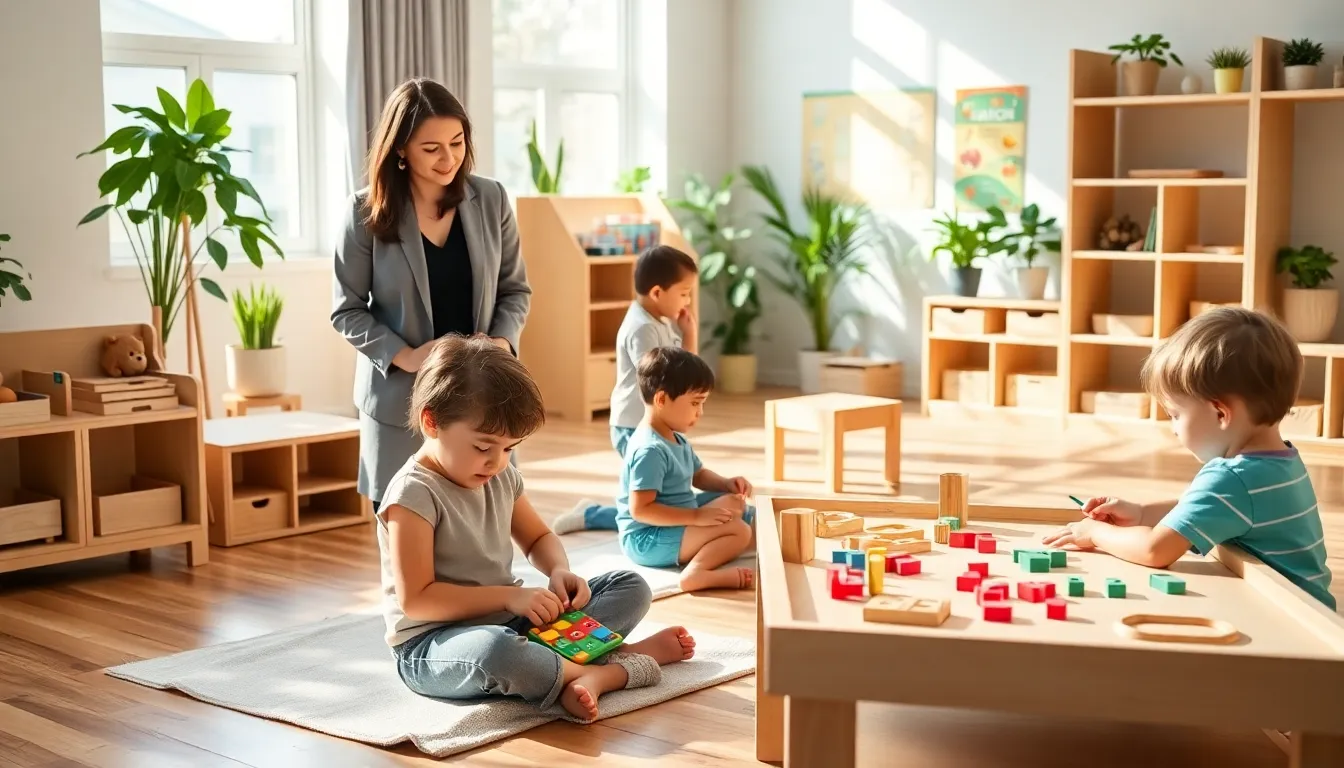
What is Montessori? This question leads parents and educators to one of the most influential educational methods in history. Montessori education puts children at the center of their own learning. It encourages independence, curiosity, and hands-on discovery. Developed over a century ago, the Montessori method now operates in thousands of schools worldwide. This guide explains the origins, principles, and benefits of Montessori education. It also helps families decide if this approach fits their child’s needs.
Table of Contents
ToggleKey Takeaways
- Montessori education is a child-centered learning method developed by Dr. Maria Montessori in 1907, emphasizing independence, curiosity, and hands-on discovery.
- Core Montessori principles include child-led learning, mixed-age classrooms, prepared environments, and uninterrupted work periods of 2-3 hours.
- Research shows Montessori students often outperform peers in reading, math, social skills, and executive function.
- Montessori classrooms are organized into five areas: Practical Life, Sensorial, Language, Mathematics, and Cultural Studies.
- When evaluating Montessori programs, look for schools accredited by AMI (Association Montessori Internationale) or AMS (American Montessori Society).
- Families can incorporate Montessori principles at home through child-sized furniture, accessible materials, and providing freedom within limits.
The Origins and Philosophy of Montessori Education
Dr. Maria Montessori created this educational method in Rome, Italy, in 1907. She was one of Italy’s first female physicians. Her medical background shaped how she observed children and their natural development.
Montessori opened her first classroom, Casa dei Bambini (Children’s House), for children in a low-income neighborhood. She noticed something remarkable. When given freedom to choose their activities, children focused deeply and learned faster. They also showed greater self-discipline than expected.
The Montessori philosophy rests on a simple belief: children are natural learners. They don’t need adults to force information into them. Instead, they need the right environment and freedom to explore. Montessori education treats each child as a capable individual with unique interests and developmental timelines.
This philosophy opposes traditional education models where teachers lecture and students listen. In Montessori settings, teachers serve as guides. They observe each child and prepare learning opportunities based on individual readiness. The child leads: the adult supports.
Montessori believed learning happens best through sensory experiences and movement. Children touch, manipulate, and experiment with materials. This hands-on approach builds deeper understanding than passive listening ever could.
Core Principles of the Montessori Method
Several key principles define what Montessori education looks like in practice.
Child-Led Learning
Montessori classrooms let children choose their own activities. A child might spend an hour with math materials one day and focus entirely on language the next. This freedom respects natural curiosity and internal motivation. Children learn because they want to, not because someone told them to.
Prepared Environment
Montessori teachers carefully design classroom spaces. Everything has a purpose and a place. Materials sit on low shelves where children can access them independently. The environment itself teaches order, independence, and responsibility.
Mixed-Age Groups
Montessori classrooms typically group children in three-year age spans. A classroom might include children ages 3-6 or 6-9. Younger children learn from older peers. Older children reinforce their knowledge by helping younger ones. This structure mirrors real-world social interactions better than same-age groupings.
Uninterrupted Work Periods
Montessori schedules include long blocks of uninterrupted time, often 2-3 hours. Children choose activities and work at their own pace without constant transitions. This supports deep concentration and allows children to complete meaningful work.
Hands-On Learning Materials
Montessori materials are distinctive. They’re designed for self-correction, meaning children can identify and fix their own mistakes. Golden beads teach math concepts. Sandpaper letters prepare hands for writing. Each material isolates one concept and engages multiple senses.
What a Montessori Classroom Looks Like
Walk into a Montessori classroom and you’ll notice immediate differences from traditional settings. There’s no teacher standing at a chalkboard. No rows of desks facing forward.
Instead, you’ll see children scattered throughout the room. Some work alone at small tables. Others sit on floor mats with materials spread before them. A few might collaborate on a project together. The teacher moves quietly among them, observing and occasionally offering guidance.
Montessori classrooms organize into distinct areas:
- Practical Life: Activities like pouring, buttoning, and food preparation build motor skills and independence
- Sensorial: Materials help children refine their senses and understand concepts like size, color, and texture
- Language: Letter work, reading materials, and writing activities support literacy development
- Mathematics: Concrete materials make abstract concepts visible and touchable
- Cultural Studies: Geography, science, art, and music round out the curriculum
The atmosphere feels calm and purposeful. Children speak in normal voices. They move freely but respectfully. Most visitors notice how focused the children appear, even very young ones.
Montessori classrooms use real, child-sized furniture and tools. Children pour water from small pitchers. They cut vegetables with real knives (supervised, of course). This practical approach builds confidence and real-world skills.
Benefits of Montessori Education for Children
Research supports many benefits of Montessori education. Studies show Montessori students often outperform peers in reading, math, and social skills.
Independence and Self-Motivation
Montessori children learn to work independently from an early age. They make choices, manage their time, and solve problems without constant adult direction. These skills transfer well beyond the classroom.
Love of Learning
Because children follow their interests, they often develop genuine enthusiasm for learning. Montessori education doesn’t rely on grades, stickers, or other external rewards. Children learn because the process itself satisfies them.
Social and Emotional Development
Mixed-age classrooms teach valuable social skills. Children practice leadership, empathy, and cooperation daily. They learn to resolve conflicts through discussion rather than adult intervention.
Academic Achievement
A 2017 study published in Frontiers in Psychology found Montessori students showed greater gains in reading, math, and executive function compared to peers in traditional programs. The hands-on, self-paced approach seems to build strong foundations.
Creativity and Critical Thinking
Montessori education values process over product. Children experiment, make mistakes, and try again. This approach nurtures creative problem-solving and independent thinking.
Not every child thrives equally in every environment. But Montessori education offers clear advantages for children who respond well to freedom, structure, and hands-on learning.
Is Montessori Right for Your Child?
Montessori education works well for many children, but it’s not automatically the best choice for every family.
Consider your child’s personality. Does your child enjoy independent exploration? Can they handle choices without becoming overwhelmed? Children who need more direct instruction or thrive on external structure might adjust slowly to Montessori settings.
Think about your own values too. Montessori education doesn’t emphasize traditional grades or assignments (especially in early years). Some parents find this refreshing. Others feel anxious without standard benchmarks.
Practical factors matter as well. Authentic Montessori schools require trained teachers and specific materials. Quality varies significantly between programs. Look for schools accredited by AMI (Association Montessori Internationale) or AMS (American Montessori Society).
Visit classrooms before deciding. Watch how teachers interact with children. Notice whether the environment feels organized and purposeful. Ask about teacher training and how the school measures progress.
Some families incorporate Montessori principles at home, even without formal schooling. Child-sized furniture, accessible materials, and freedom within limits can benefit any household.
Montessori education continues growing in popularity for good reason. It respects children as individuals and prepares them for lifelong learning.